
Uncategorized
Ukadiche Modak Recipe – Authentic Maharashtrian Steamed Modak
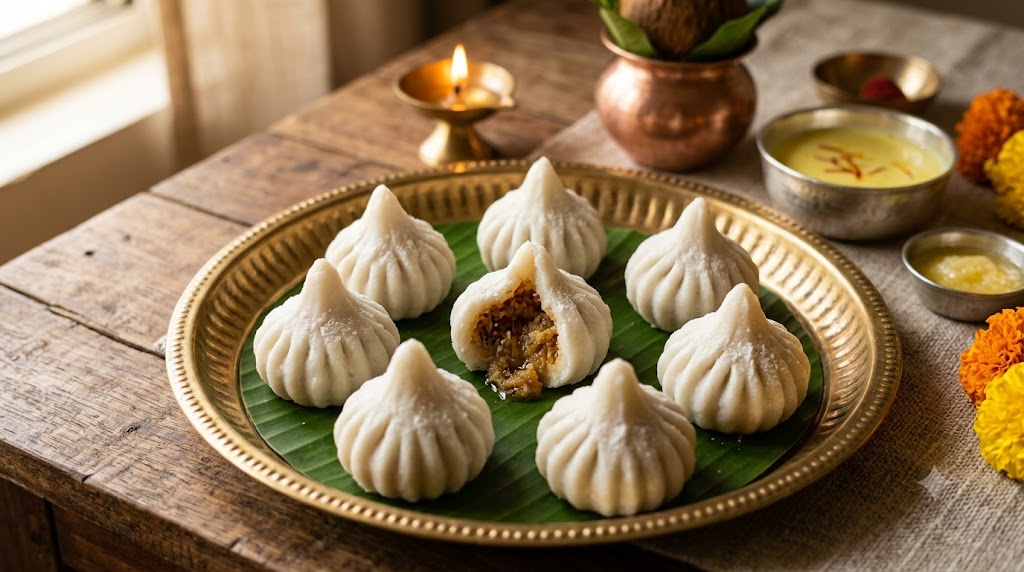
There’s a sound in every Maharashtrian kitchen right before Ganesh Chaturthi, and it’s not the aarti bells. It’s the hiss of a modak patra on the stove, followed a few minutes later by someone muttering that the ukad isn’t coming together right. This ukadiche modak recipe is the one I’ve come back to every year, because it’s the version that actually works.
Ukadiche modak, the steamed rice-flour dumpling stuffed with coconut and jaggery, is the one dish almost every Maharashtrian household makes without fail, and almost nobody gets perfect on the first try. That’s not a knock on anyone’s cooking. Scalded rice dough is unforgiving, the pleating takes real hands-on practice, and every rice flour brand behaves just differently enough to throw off a recipe you thought you knew.
This is the version I actually make at home, no shortcuts. Steamed, not fried. Real rice flour dough, not a maida cheat. Coconut and jaggery cooked down the slow way, the way it’s been done for generations, no condensed milk or store-bought khoya standing in.
This is the version I actually make at home, no shortcuts, the same style of real, unfussy cooking you’ll find across Sugran Kitchen. Steamed, not fried. Real rice flour dough, not a maida cheat. Coconut and jaggery cooked down the slow way, the way it’s been done for generations, no condensed milk or store-bought khoya standing in.
What Is Ukadiche Modak?
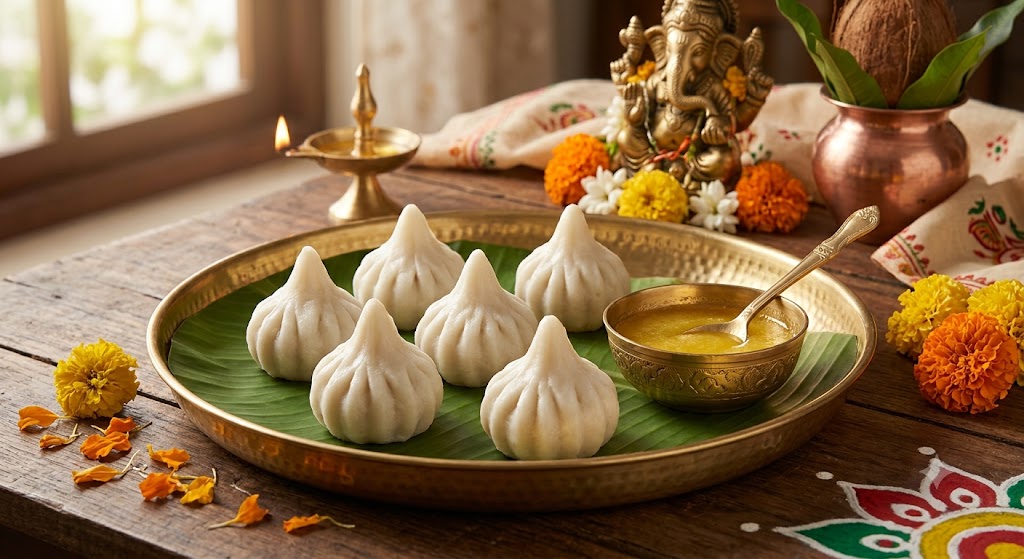
Ukadiche modak literally translates to “steamed modak.” Ukad refers to the scalded rice-flour dough used for the outer shell, cooked with boiling water rather than kneaded raw, which is what gives these modaks their soft, slightly translucent skin once steamed. Inside sits a filling called saran or sarn: fresh grated coconut cooked with jaggery until it thickens, usually with a hit of cardamom.
This is different from the fried modak variants (talniche modak) you’ll find at sweet shops, and different again from the chocolate or mawa-stuffed modern versions. Ukadiche modak is the traditional offering, the one made specifically for Ganpati.
The shape matters too. A proper ukadiche modak has pleats pinched around the top, gathered and twisted into a point, meant to resemble a closed lotus bud. Getting those pleats even takes practice. Nobody’s first batch looks like the ones in photos, and that’s fine.
Why Is Modak Important During Ganesh Chaturthi?
Modak is considered Lord Ganesha’s favorite sweet, and it’s the centerpiece of the naivedya (food offering) made to him during Ganesh Chaturthi, the ten-day festival celebrating his birth. The story most commonly told is that Ganesha simply loves modaks so much that no Ganpati puja feels complete without them, but the dish also carries older symbolism: the sweet filling wrapped inside a humble rice-flour shell is often read as a metaphor for the sweetness of knowledge or inner joy protected within a simple exterior.
Practically speaking, most Maharashtrian households make a batch of 21 modaks (an auspicious number) on the first day of Ganeshotsav, offer some to the idol, and share the rest with family.
If you’re planning the rest of your Ganpati spread, you’ll find more festival recipes on the Sugran Kitchen recipes page, and once the Puran Poli post is live, it’ll link from here too.
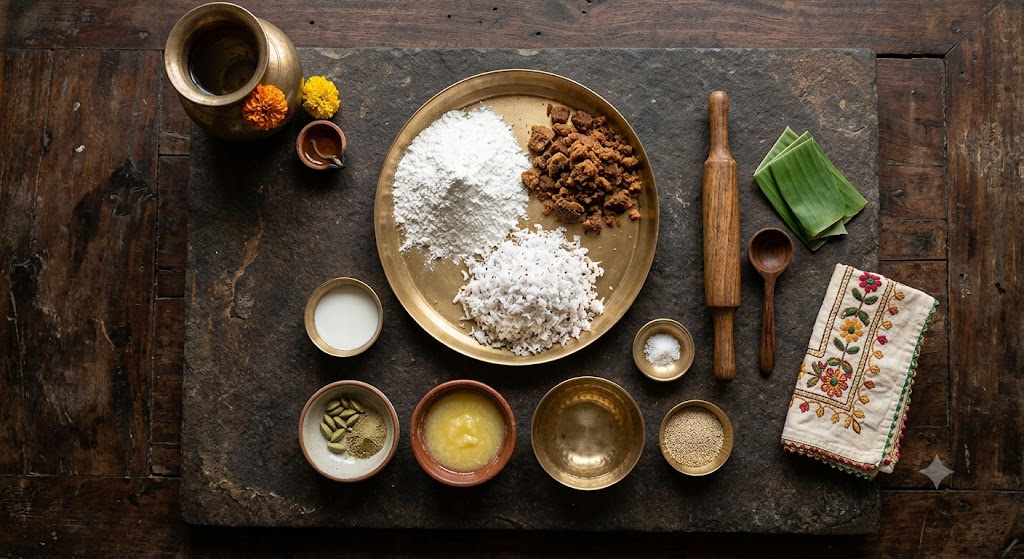
Ukadiche Modak Recipe: Ingredients
This recipe makes 16 medium modaks.
For the ukad (outer dough):
- Rice flour — 1 cup (150 g), fine grind, ideally the kind sold specifically for idiyappam/modak
- Water — 1½ cups (360 ml)
- Ghee — ¼ tsp
- Salt — ¼ tsp
Note that the water quantity here (1½ cups to 1 cup flour) runs a bit higher than the simple 1:1 ratio some recipes quote. This matches the proportions used in Dassana’s widely-followed modak recipe and gives a softer, more pliable ukad, since fine modak-grade rice flour tends to need slightly more water to scald properly than coarser rice flour does.
For the saran (coconut-jaggery filling):
- Fresh grated coconut — 1 cup (100 g)
- Jaggery — 100 to 120 g (roughly ¾ cup; see note below)
- Cardamom powder — 1 tsp
- Poppy seeds (khus khus) — ½ tsp, optional
- Nutmeg powder — ¼ tsp, optional
- Ghee — ½ tsp
On the jaggery quantity: a lot of published modak recipes call for a 1:2 coconut-to-jaggery ratio (100 g coconut to 200 g jaggery), which makes for a noticeably sweet filling. For a more traditional Maharashtrian result, keep it closer to 1:1 by weight, 100 g coconut to 100 to 120 g jaggery. The coconut flavor comes through properly instead of getting buried, and it’s closer to how the filling is actually made in most home kitchens rather than at sweet shops, where the extra jaggery also helps the filling hold together for display.
Batch scaling (keep the ukad at 1 part rice flour to 1.5 parts water by volume):
| Batch size | Rice flour | Water | Coconut | Jaggery |
|---|---|---|---|---|
| Standard (16 modaks) | 150 g (1 cup) | 360 ml (1½ cups) | 100 g (1 cup) | 100–120 g |
| Double (32 modaks) | 300 g (2 cups) | 720 ml (3 cups) | 200 g (2 cups) | 200–240 g |
| Triple (48 modaks) | 450 g (3 cups) | 1080 ml (4½ cups) | 300 g (3 cups) | 300–360 g |
If you specifically want the traditional 21-modak batch for Ganeshotsav, scale everything by 1.3x (roughly 195 g rice flour, 470 ml water, 130 g coconut, 130–155 g jaggery), then round to whatever’s easiest to measure.
How to Make the Coconut-Jaggery Filling (Saran)
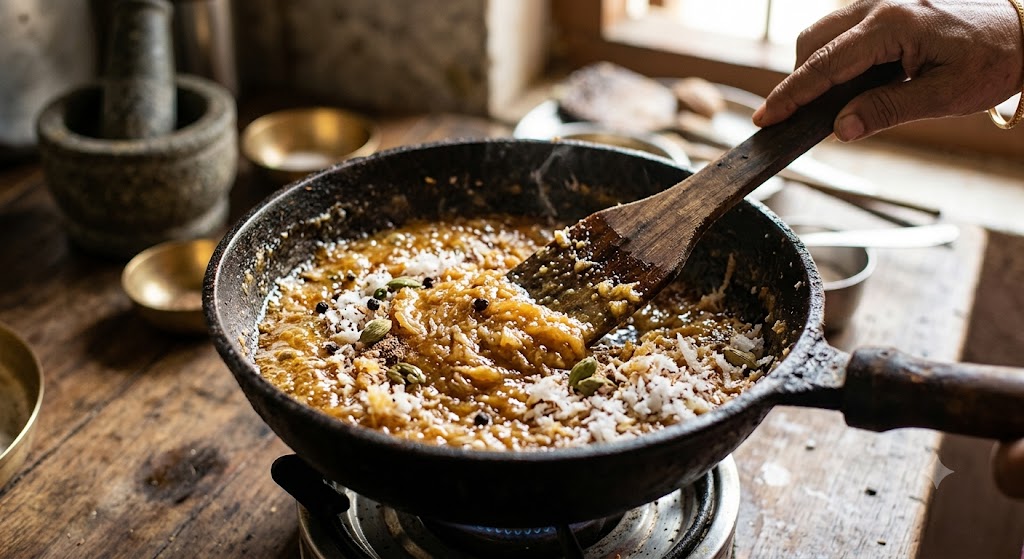
- Heat a heavy-bottomed pan on medium flame and add the ghee.
- Add the grated coconut and roast lightly for a minute, just until it smells fragrant. Don’t let it brown.
- Add the jaggery. It will start to melt and release water almost immediately, this is normal.
- Keep stirring on medium-low heat. The mixture will loosen up first, then slowly start to thicken as the water cooks off.
- Cook until the mixture pulls together and leaves the sides of the pan, roughly 8 to 10 minutes. It should hold its shape when you press a spoonful together, not be runny.
- Stir in the cardamom powder, and the poppy seeds and nutmeg powder if using.
- Turn off the heat and let the filling cool completely before you try to shape modaks. Warm filling makes the dough tear.
The biggest mistake people make here is undercooking the filling. If it’s still wet when you turn off the heat, it’ll seep through the dough while steaming and you’ll end up with soggy, sticky modaks. You want it dry enough to roll into a rough ball between your palms without sticking to your hands.
How to Prepare the Ukad (Rice-Flour Dough)
- In a pan, bring the water to a rolling boil with the ghee and salt.
- Turn off the heat, then add the rice flour all at once, stirring quickly with a spoon or spatula.
- Cover the pan immediately and let it sit for 4 to 5 minutes. This is the “scalding” step, and it’s what makes ukad different from a regular dough. The residual steam cooks the flour.
- Once cooled just enough to handle (still warm, not hot), transfer to a plate or bowl and knead with slightly greased hands until smooth. This takes about 2 to 3 minutes. The dough should be soft, pliable, and not sticky.
- Cover with a damp cloth immediately. Rice flour dough dries out and cracks fast, so don’t let it sit exposed to air while you’re shaping.
If the dough feels dry or is cracking as you knead it, wet your hands with a little warm water and keep kneading rather than adding water directly to the dough. If it’s too sticky, a light dusting of extra rice flour will fix it, but go slow, a little goes a long way.
How to Shape Modaks
Shaping is the step that makes or breaks this ukadiche modak recipe, and it’s the one that takes the most practice.
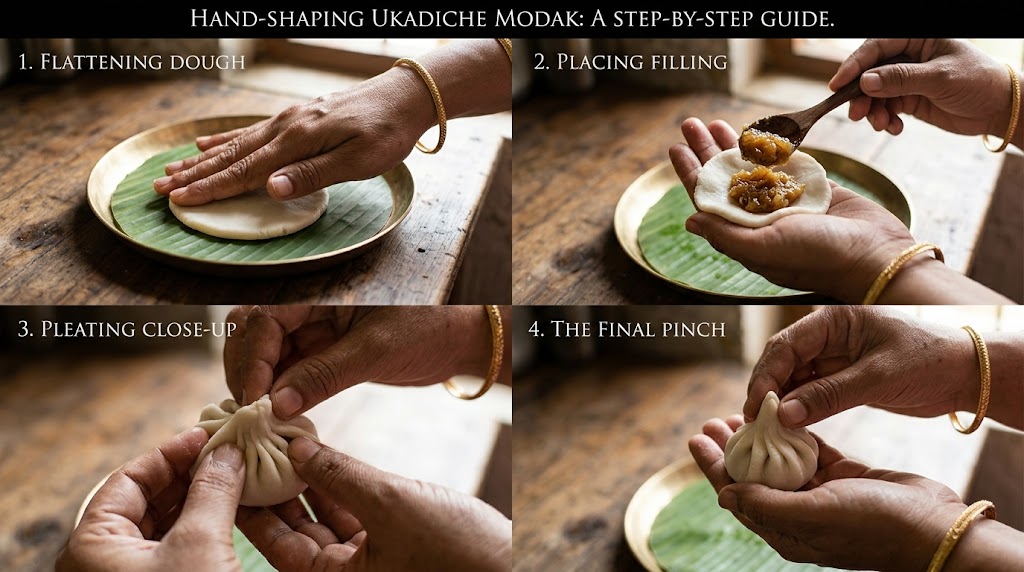
- Grease your palms lightly with ghee.
- Take a small lemon-sized ball of dough and flatten it into a disc about 2.5 to 3 inches wide, either in your palm or on a greased surface. Keep the edges slightly thinner than the center.
- Place about a tablespoon of the cooled filling in the center.
- Using your thumb and index finger, start pleating the edge of the disc, working around the circle. Each pleat should overlap slightly with the last.
- Once you’ve gone all the way around, gather all the pleats together at the top and gently twist to seal into a point, pinching off any excess dough.
- Set the shaped modak on a greased plate and cover with a damp cloth while you shape the rest, so they don’t dry out.
If pleating feels impossible at first, you’re not alone. A common workaround while you’re learning: use a modak mould (widely available, plastic or steel, two-part hinged mould). Press dough into the mould, add filling, close it, and pop the shaped modak out. It won’t look quite as delicate as hand-pleated ones, but it steams and tastes exactly the same, and it’s a completely legitimate way to make these at home.
How to Steam Them Perfectly
- Line your steamer or idli plate/modak patra with a greased banana leaf, muslin cloth, or just grease it directly with ghee so the modaks don’t stick.
- Arrange the modaks with a little space between each, they don’t expand much but can stick together if crowded.
- Steam on medium-high heat for 10 to 12 minutes. The dough will turn slightly glossy and translucent when done.
- Don’t over-steam. Past about 15 minutes the outer layer starts to toughen and lose that soft, slightly chewy texture that’s the whole point of ukadiche modak.
- Let them rest for 2 minutes off the heat before removing, they’re fragile straight out of the steamer and can tear if handled immediately.
- Serve warm with a spoon of ghee on top.
Common Problems and How to Fix Them
Even with the exact right measurements, this ukadiche modak recipe can still go sideways in a few predictable ways.
Dough is cracking while shaping. Usually means it’s cooled too much or wasn’t kneaded long enough while warm. Keep a small bowl of warm water nearby and wet your fingertips as you work.
Modaks stuck together after steaming. Not enough space between them on the plate, or not greased well enough beforehand. Grease generously and give them breathing room.
Filling leaking out during steaming. The saran was too wet before you sealed the modak, or the pleats/seal at the top weren’t pinched firmly enough. Cook the filling until properly dry, and make sure that top twist is sealed tight.
Dough turned gummy or gluey after steaming. Usually too much water in the ukad, or the flour wasn’t scalded long enough in step 3 of the dough method. Give it the full covered resting time before kneading.
Modaks look flat or collapsed instead of holding their shape. The dough disc was rolled too thin, or the filling was too soft/warm when you shaped around it. Cooled filling and a slightly thicker edge on the dough disc both help.
How to Store Modaks
Ukadiche modaks are best eaten fresh, ideally the same day, since the rice-flour shell firms up and loses its softness as it sits.
Best eaten fresh. If storing, keep in an airtight container in the fridge for up to 2 days, and reheat by steaming again for 2 to 3 minutes rather than microwaving.
They don’t freeze particularly well once steamed, the texture of the shell changes noticeably on thawing. If you want to prep ahead, you can shape the raw modaks, freeze them uncooked on a tray until firm, then transfer to a container, and steam directly from frozen (add a couple of extra minutes to the steaming time).
Nutrition Information
Approximate values per modak, calculated from the exact ingredient quantities in this recipe (16 modaks per batch, using the 100 to 120 g jaggery range):
- Calories: about 82 to 87 kcal
- Carbohydrates: about 15 to 16 g
- Protein: about 1 g
- Fat: about 2.5 g
- Sugar: about 6 to 7 g (almost entirely from the jaggery)
These are calculated estimates based on standard nutrition values for rice flour, fresh coconut, jaggery, and ghee, not a lab analysis of your specific batch. Note that these numbers come out noticeably lower than a 1:2 coconut-to-jaggery version of this recipe, that’s the direct effect of keeping the filling closer to 1:1, less jaggery means less sugar and fewer calories per modak, alongside the more balanced flavor. If poppy seeds are added, add roughly 3 to 4 kcal per modak. For a site nutrition field that needs to be defensible (especially since AdSense content quality is a factor here), I’d frame this as “approximate, calculated from ingredients” rather than presenting it as verified lab data, that phrasing is accurate and also protects you if a reader’s own numbers come out slightly different due to flour or jaggery brand.
Conclusion:
If there’s one thing to take from all of this, it’s that ukadiche modak forgives practice, not perfection. Your pleats won’t look like the photos the first time, the dough will probably crack somewhere along the way, and that’s genuinely fine. Every home cook making these this Ganeshotsav is working through the exact same wrinkles. What matters is the coconut and jaggery inside, steamed soft, offered warm. That part’s hard to get wrong.
Made these? I’d love to see them. Tag @originalsugrankitchen on Instagram with your batch, cracked pleats and all, that’s half the fun of this dish anyway. And if you’d rather read this recipe in Hindi or Marathi, both versions are up on the site too, just use the language toggle above.
Frequently Asked Questions
Yes, hand-pleating is the traditional method and doesn’t require any equipment beyond your hands and a greased surface. It just takes practice.
Fine rice flour made specifically for idiyappam or modak works best because of how finely it’s milled. Regular rice flour works too, but check the packet, coarser grinds can make the dough grainy.
Usually too much water relative to the flour, or the flour wasn’t scalded long enough before kneading. A light dusting of extra rice flour while kneading usually corrects it.
Yes, jaggery powder works fine and can actually be easier to measure and melt evenly than chopped block jaggery.
This recipe makes 16 medium-sized modaks. For the traditional 21-modak batch made for Ganeshotsav, scale the ingredients by 1.3x (see the batch scaling table above).
The filling and dough are naturally vegan except for the ghee used in cooking and greasing. Substituting a neutral oil for greasing and cooking makes the whole recipe vegan, though the flavor will differ slightly.
No Comments Yet
Be the first to share your thoughts!